
Stephen King’s The Shawshank Redemption has captivated viewers for decades because beneath its emotional arc lies a deeper commentary on what happens when flawed people are given unchecked power.
In a 2016 interview, Stephen King was asked if he had “a personal favorite” film adaptation of one of his stories. The first movie out of the bestselling author’s mouth was not Carrie or Misery. It was not The Shining, the Stanley Kubrick film King famously hated. It wasn’t Pet Semetary or It.
The film King mentioned was Shawshank Redemption, Frank Darabont’s adaptation of the novella Rita Hayworth and the Shawshank Redemption, which appeared in King’s 1982 work Different Seasons.
That King would mention this movie isn’t exactly a surprise. Shawshank Redemption is widely considered one of the greatest movies ever made. In 2007, the American Film Institute ranked it 72 all-time, ahead of such films as Forrest Gump, Platoon, Good Fellas, and Titanic. Not bad for a movie with a $25 million budget.
Nearly 30 years after its release, it remains stubbornly popular. It’s a source of countless internet memes and seems to run endlessly on cable. I was recently in a hotel with my family and the movie was on TBS, as it always seems to be. My 10-year-old son couldn’t get enough of it. During commercials he peppered me with one question after another. Is prison really like that? Are all the men in there bad? What were they doing to him?
The reason Shawshank Redemption remains so popular today isn’t a mystery: it’s a masterpiece of filmmaking in an era that is struggling to tell good stories. Through Andy Dufresne (Tim Robbins) and Red (Morgan Freeman), viewers experience fear and suffering in Shawshank Prison. Loss and pain. Hope and friendship. Injustice and oppression and, ultimately, redemption.
There’s no question that Robbins and Freeman own this film. Their performances stand above all others.
When you think of Shawshank Redemption, you think of Andy Dufresne and Red, the criminal heroes who forge a unique friendship in Maine’s hell-like prison. But the reason redemption tastes so sweet in the end has a lot to do with the people who made Shawshank Prison hell in the first place.
The Villains of Shawshank
The Characters Whose Personal Cruelty Define the Darkness Andy Endures
One of the things that makes Stephen King a great storyteller is how uniquely evil the villains in his stories are. I’m not talking about Pennywise, the clown in It, or Kurt Barlow, the vampire in Salem’s Lot, who are merely scary. I’m talking about the nasty, evil people in his stories. Guys like Ace in Stand By Me, Percy Wetmore in The Green Mile, and Henry Bowers in It.
These are deliciously nasty characters, ones we can’t help but loathe, in large part because there is something so real and relatable in their villainy. Anyone who has experienced the petty cruelty of a schoolyard bully-tyrant doesn’t just dislike Ace Merrill; he understands him at a visceral level.
In Shawshank Redemption, King went above and beyond in the villain department. The story has some of the most memorable villains in all of film, each uniquely detestable in his own way. There’s the inmate Boggs, who attacks and rapes Andy (before he meets his own unwelcome fate). There’s Byron Hadley, the sadist guard who kills an inmate during his first night in prison when he can’t stop crying. And there’s Warden Norton, the Bible-quoting administrator of Shawshank who uses Andy to run his corrupt prison schemes.
When I was watching Shawshank in my hotel with my son, I was trying to decide which of these villains was the worst. It’s not easy. Boggs is a rapist. Hadley, meanwhile, kills multiple people during the course of the film, one of them in cold blood, and nearly throws Andy off the roof. And then there’s Warden Norton. He is not just crooked; he puts Andy in “the hole” (solitary confinement) for a month when he learns Andy is innocent of the crime he was convicted of.
And that’s when it hit me.
The Real Villain in Shawshank Redemption
How the Film Reveals a Deeper Antagonist: the Unchecked Power of the State
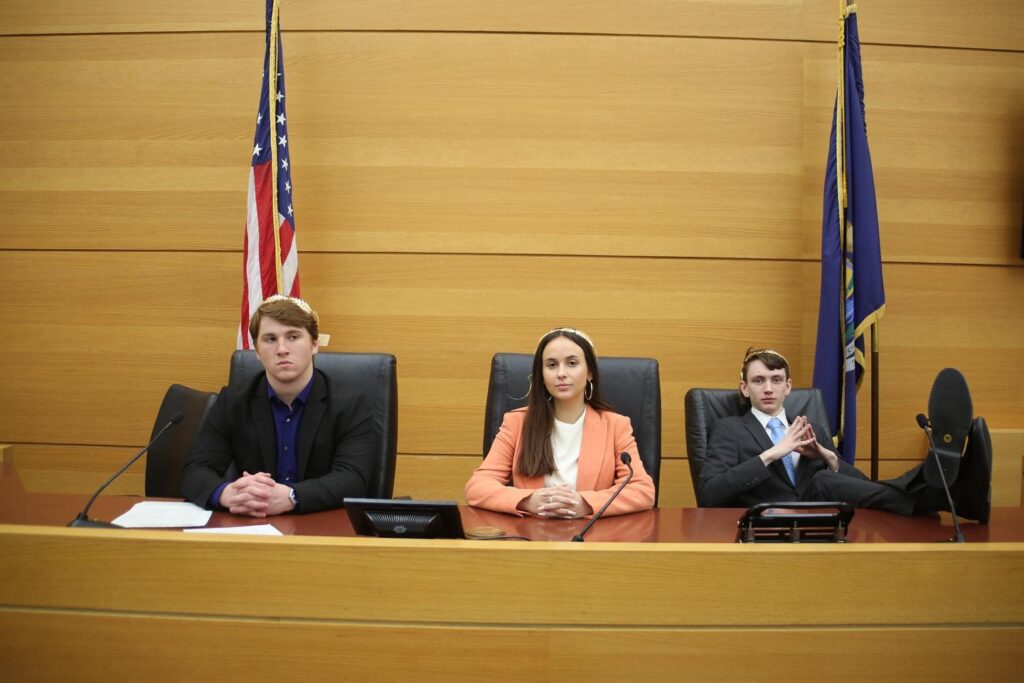
It’s easy to overlook that simple part of the movie: Andy Dufresne is an innocent man.
We don’t know this immediately in the film. At the very beginning, we see Andy convicted in a courtroom for murder. His wife was brutally killed, along with her lover, and from a flashback, we see that Andy was sitting outside their hotel room with a loaded pistol:
District Attorney: When they arrived, you went up to the house and murdered them.
Dufresne: No. I was sobering up. I got back in the car and I drove home to sleep it off. Along the way, I stopped and I threw my gun into the royal river. I feel I’ve been very clear on this point.
District Attorney: Well where I get hazy is where the cleaning woman shows up the following morning and finds your wife in bed with her lover riddled with 38 caliber bullets. Now, does that strike you as a fantastic coincidence, Mr. Dufresne, or is it just me?
Dufresne: Yes, it does.
District Attorney: Yet you still maintain that you threw your gun into the river before the murders took place. That’s very convenient.
Dufresne: It’s the truth.
District Attorney: The police dragged that river for three days and nary a gun was found. So there could be no comparison made between your gun and the bullets taken from the blood-stained corpses of the victims. And that, also, is very convenient, isn’t it, Mr. Dufresne.
Dufresne: Since I am innocent of this crime, sir, I find it decidedly inconvenient that the gun was never found.
Though Andy maintains he is innocent, a judge moments later announces the verdict and sentence.
“By the power vested in me by the State of Maine, I hereby order you to serve two life sentences back-to-back, one for each of your victims. So be it!”
Only later in the film do we learn that Andy was telling the truth. He didn’t kill his wife. A man named Elmo Blatch did.
In other words, Andy Dufresne was sentenced to two life sentences for a crime he didn’t commit. This happens in the United States more than people realize. According to the Innocence Project, 375 people convicted of felonies have been exonerated by DNA testing as of January 2022. Of those, 21 had been sentenced to die.
This brings me to the overlooked “villain” in Shawshank Redemption: the state.
‘Fingers in a Lot of Pies’
The Layers of Corruption Operating Beneath Shawshank’s institutional Surface
It’s not just that Andy Dufresne was wrongly convicted of murder. (No criminal justice system is perfect, after all, and one could argue there was considerable circumstantial evidence suggesting that Dufresne murdered his adulterous wife.) Throughout the film, we see Dufresne is the victim, as are others, of a system that is at best dysfunctional and at worst evil.
As mentioned, on Andy’s first night in prison, viewers see Byron Hadley murder an inmate who is crying for his mother and saying that he doesn’t belong in prison. As far as we know, Hadley isn’t even reprimanded for this act, let alone charged.
We also see the prison fail to protect inmates. Andy is raped and beaten by Boggs several times. This seems to be of little consequence to Warden Norton or the guards until Andy becomes useful to prison officers because of his accounting skills. Once Andy’s utility is realized, Hadley is dispatched to deal with Boggs, who is beaten so badly he spends the remainder of his days “drinking his food through a straw.”
This is good news for our hero; “the Sisters never laid a finger on Andy again,” Red tells us, but the abuse Andy experiences doesn’t speak highly to the prison system. Sadly, evidence shows such occurrences are shockingly common, even today. As The New York Times notes, data from the Bureau of Justice Statistics show around 80,000 men and women are sexually assaulted in U.S. correctional facilities each year.
In other words, Shawshank Redemption is showing us the reality of prison life. One we’re vaguely aware of but choose to tolerate as a society, either because inmates are seen as “animals” or because we don’t want to admit it’s the bureaucratic nature of the state and the lack of incentives and accountability in the system that perpetuates the abuse.
Whatever the case, it’s clear to viewers that Shawshank Prison is completely corrupt:
Red: [The Warden’s] got his fingers in a lot of pies, from what I hear.
Andy Dufresne: What you hear isn’t half of it. He’s got scams you haven’t even dreamed of. Kickbacks on his kickbacks. There’s a river of dirty money running through this place.
Corruption is an age-old problem, but it’s one that afflicts government institutions above all others, and in Shawshank Redemption we see why.
‘The Worst Evils’
Systemic Power, Not Individual Men, Enables Abuse Without Accountability
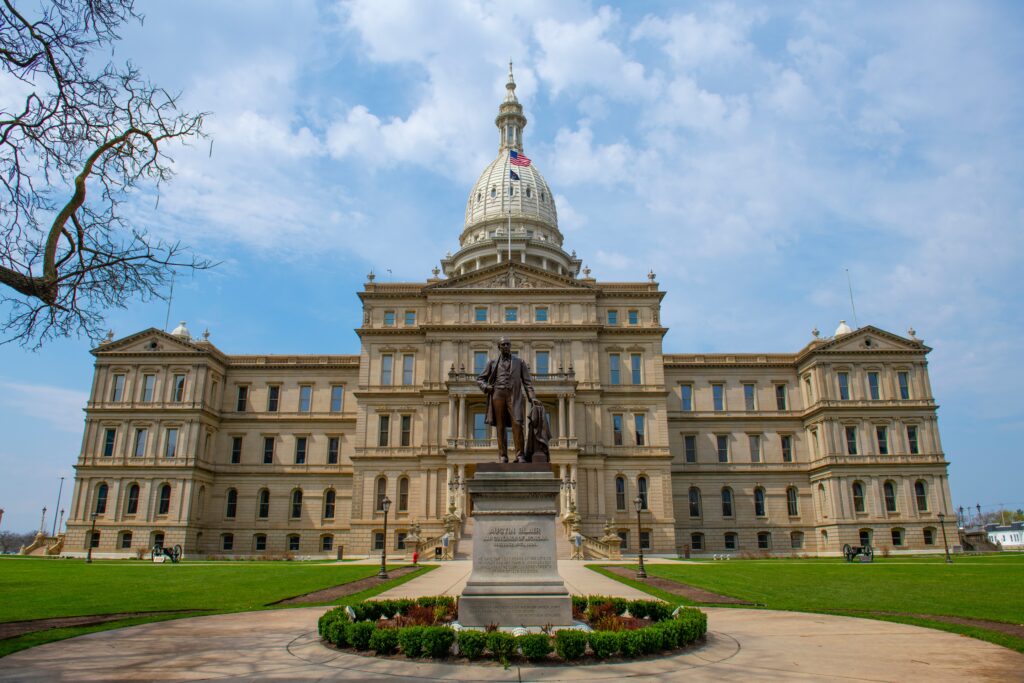
All of this shows why the real villain in Shawshank Redemption is the state. Boggs, Hadley, and Warden Norton are all bad men, of course. But it’s the system that allows them to be monsters—and to get away with it.
All of these men, it’s safe to assume, would be bad outside the prison system. Boggs is in prison for a reason, after all. He’s a rapist. But Hadley and Norton are free men. And while they might be men of low character on the outside, it’s within the state’s prison system that they’re able to commit crimes with impunity. No one is there to guard the guards themselves. (Quis custodiet ipsos custodes?) No one is there to hold them accountable.
There’s a Lesson Here
A Story of Hope Within a Broken System
The economist Ludwig von Mises once observed that there will always be bad men in the world, but it’s when these men are given the raw power of the state that we should really worry.
“There is no more dangerous menace to civilization than a government of incompetent, corrupt, or vile men,” Mises wrote. “The worst evils which mankind ever had to endure were inflicted by bad governments.”
This is precisely why America’s Founding Fathers feared centralized power, which they saw as a dangerous and corrupting force. And it’s why they dispersed power and created various checks and balances on government, which they believed should be limited.
To be clear, I’m not arguing that Shawshank Redemption is a libertarian treatise or a political manifesto. It’s not. It’s a work of art that beautifully and poetically shows an individual experiencing injustice and evil on a scale few of us could imagine—and overcoming it.
Still, it would be a mistake to overlook that the true villain in the story isn’t Boggs, Hadley, or even Warden Norton. It’s the system that empowers them.
About the Author
Jonathan Miltimore is the Editor at Large of FEE, the Foundation for Economic Education. His writing/reporting has been the subject of articles in TIME magazine, The Wall Street Journal, CNN, Forbes, Fox News, and the Star Tribune. He has been published by Newsweek, The Washington Times, MSN.com, The Washington Examiner, The Daily Caller, The Federalist, and the Epoch Times. He previously served in editorial roles at The History Channel magazine, Intellectual Takeout, and Scout. Jon is an alumni of the Institute for Humane Studies journalism program, a former reporter for the Panama City News Herald; and an intern in the speechwriting department of George W. Bush.
This article originally was published by the Foundation for Economic Freedom.