A former vice chairman of the New York Stock Exchange encouraged Northwood University students to take risks, challenge conventional thinking and recognize the importance of personal relationships during a wide-ranging discussion about leadership, financial markets and the future of business.
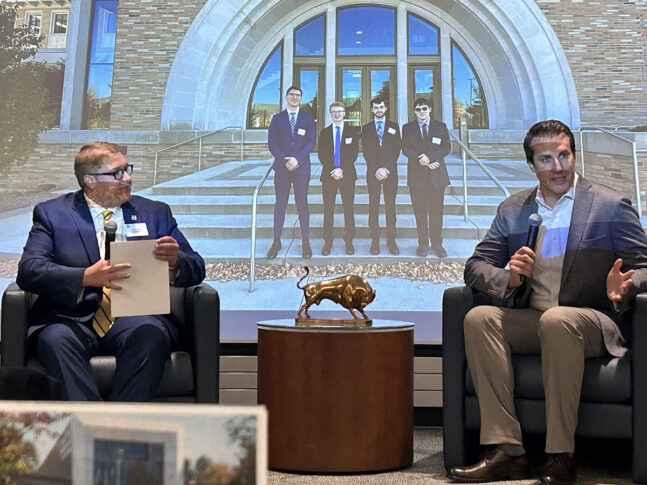
During his 17-year career at the New York Stock Exchange, John Tuttle held leadership roles in which he helped oversee more than 1,300 equity offerings that raised over $1.5 trillion. He was the featured speaker at the Finance Association of Northwood University’s sixth annual Financial Leadership Summit on Friday, Nov. 13.
The event, held at the Plaster Free Enterprise Center at Northwood University, featured a conversation moderated by Finance Association President Collin Ridgway, a junior from Flint, Michigan, who guided Tuttle through topics ranging from his unconventional career path to the impact of artificial intelligence on the financial industry. Students and other attendees also had opportunities to ask questions directly.
“Today is about more than just finance. It’s about leadership,” Ridgway said in his opening remarks. He emphasized the value of connecting with successful professionals willing to share their experiences with the next generation of business leaders.
Tuttle grew up in Michigan and began his career in public service, working in the White House and U.S. Department of State before moving to Wall Street. His background in government and international relations ultimately became an advantage as the New York Stock Exchange expanded its global operations.
His message to students was that meaningful career opportunities often emerge from unexpected experiences.
Tuttle encouraged students to pursue interests that differentiate them from their peers, explaining that seemingly unrelated experiences can provide valuable perspectives and open doors later in life.
He also stressed the importance of remaining curious and receptive to new ideas, recalling his interactions with prominent business executives during his years at the exchange.
Tuttle said a defining characteristic of the most successful leaders he encountered was their willingness to listen and learn. Executives who remained focused on understanding their businesses and customers, rather than the prestige associated with their positions, were often better equipped to lead successful organizations.
That willingness to question established practices also helped shape one of the most memorable experiences of his career: developing a new pathway to the public markets for Spotify.
Tuttle recounted how Spotify’s leadership questioned whether the company needed to follow the traditional initial public offering process when it was not seeking to raise additional capital. Working with the New York Stock Exchange, the company pursued a direct listing, allowing existing shares to trade publicly without a conventional IPO.
Spotify began trading on the exchange in 2018, and its approach subsequently influenced other companies considering alternatives to traditional public offerings.
For Tuttle, the experience demonstrated what can happen when business leaders challenge longstanding assumptions and develop solutions around the needs of their customers.
The conversation also explored the evolving relationship between public and private markets. Tuttle expressed concern that an increasing amount of wealth is being created while companies remain privately held, limiting opportunities for everyday investors to participate in their growth.
He discussed the importance of finding ways to expand access to those investment opportunities while maintaining the investor protections, transparency and liquidity associated with public markets.
Throughout the summit, Tuttle repeatedly returned to the human element of business.
“Business is done by people,” he told attendees, emphasizing that relationships developed early in a career can lead to unexpected opportunities decades later.
He encouraged students to build professional networks, reach out to alumni and business leaders, and recognize that successful professionals often welcome opportunities to help younger generations.
That emphasis on human connections extended to his perspective on artificial intelligence.
Responding to a question from a Northwood freshman about AI’s potential impact on jobs and cybersecurity, Tuttle acknowledged that technological advances could create significant short-term disruption. However, he encouraged students to view emerging technology as an opportunity to become more effective and create new value.
He explained that combining technological capabilities with human judgment, oversight and accountability is essential, particularly in financial markets where public confidence is critical.
“Confidence underpins markets,” Tuttle said. “If you don’t have confidence, you don’t have markets.”
He suggested that AI could give young professionals the ability to accomplish work that previously required extensive time and resources, potentially creating opportunities for entrepreneurs to compete with much larger organizations.
Tuttle also encouraged students to develop informed opinions and contribute their perspectives in professional settings, even when those views differ from conventional thinking.
He emphasized that success frequently develops through years of accumulating knowledge, refining skills and building relationships rather than arriving immediately.
“If success doesn’t come immediately, it doesn’t mean it’s not coming,” he said.
He urged students to pursue ambitious opportunities rather than allowing uncertainty or fear of rejection to limit their ambitions.
“Throw the long ball,” Tuttle advised.
The summit concluded with Tuttle reflecting on the value of free enterprise and the opportunities available to students preparing to enter the business world. He also endorsed Northwood University’s commitment to those principles, telling students they are fortunate to attend an institution that openly celebrates the foundations of America’s economic success.
He recalled being struck by the flags lining Northwood’s entrance roads, which feature messages such as “Liberty and Business for All” and “America’s Free Enterprise University,” along with other statements celebrating freedom, entrepreneurship and free markets.
For Tuttle, those messages represent more than campus branding. They reflect principles that have helped create extraordinary opportunities for individuals to build businesses, generate wealth and improve lives.
“You’re also very fortunate to be at this institution,” Tuttle told students, referencing the campus signage promoting free enterprise, freedom and the ability to determine one’s own future. “… I’m glad you’re leaning into it because it’s easy and sometimes popular to bash it because it’s not perfect, but it has improved the quality of life for so many people and will continue to with people like you at the helm.”
The former Wall Street executive concluded by expressing confidence in the next generation of business leaders, particularly those who chose to spend their Friday learning about financial markets and leadership.
“If there was an ETF where I could bet on all of you, I would,” he told students, referring to an exchange-traded fund.
The annual Financial Leadership Summit is among the professional development opportunities organized by the Finance Association of Northwood University (FANU). Through networking events, industry engagement, academic competitions and visits to financial institutions, the student organization helps connect classroom learning with the realities of the financial industry.
For more information, visit the FANU webpage.