Learn More About The Philosophy of Free Enterprise Through Northwood University.

America is a place that has always appealed to people seeking opportunity to create a better life for themselves and their children. That is in no small part because our system of limited government was specifically designed to secure individual rights, but leave people otherwise free to pursue their own path in life. The result has been a dynamic entrepreneurial and civic culture and the world’s highest standard of living.

In The Philosophy of Free Enterprise course, you will learn about the importance of business in society, the ethical foundations of the capitalist system, the meaning of free enterprise and the ways in which it benefits us, limited government and the rule of law, and the differences between capitalism and other economic systems.

Heading here

Two men in business suits stand outdoors at a formal Northwood University event, conversing, with other people and tables visible in the blurred background—perhaps discussing the impact of the Northwood Idea.

The Importance of Business

This module highlights how business, driven by innovation rather than just capital, has transformed human life over time. In a free enterprise system, success comes from serving others and solving problems, not just seeking profit. Entrepreneurs play a key social role, and their creativity and impact on our daily comfort and progress deserve more recognition.

Four individuals are overlaid on a financial graph featuring various statistical data points, lines, and charts, representing economic trends and analysis.

The Free Enterprise System

This module explains how the free enterprise system, built on economic freedom, private property, market prices, and free trade, leads to greater prosperity, innovation, and sustainability. It highlights how prices coordinate our actions, trade boosts productivity, and private property secures rights and incentives. Contrary to common belief, free markets often promote better environmental outcomes, as seen in countries with higher economic freedom.

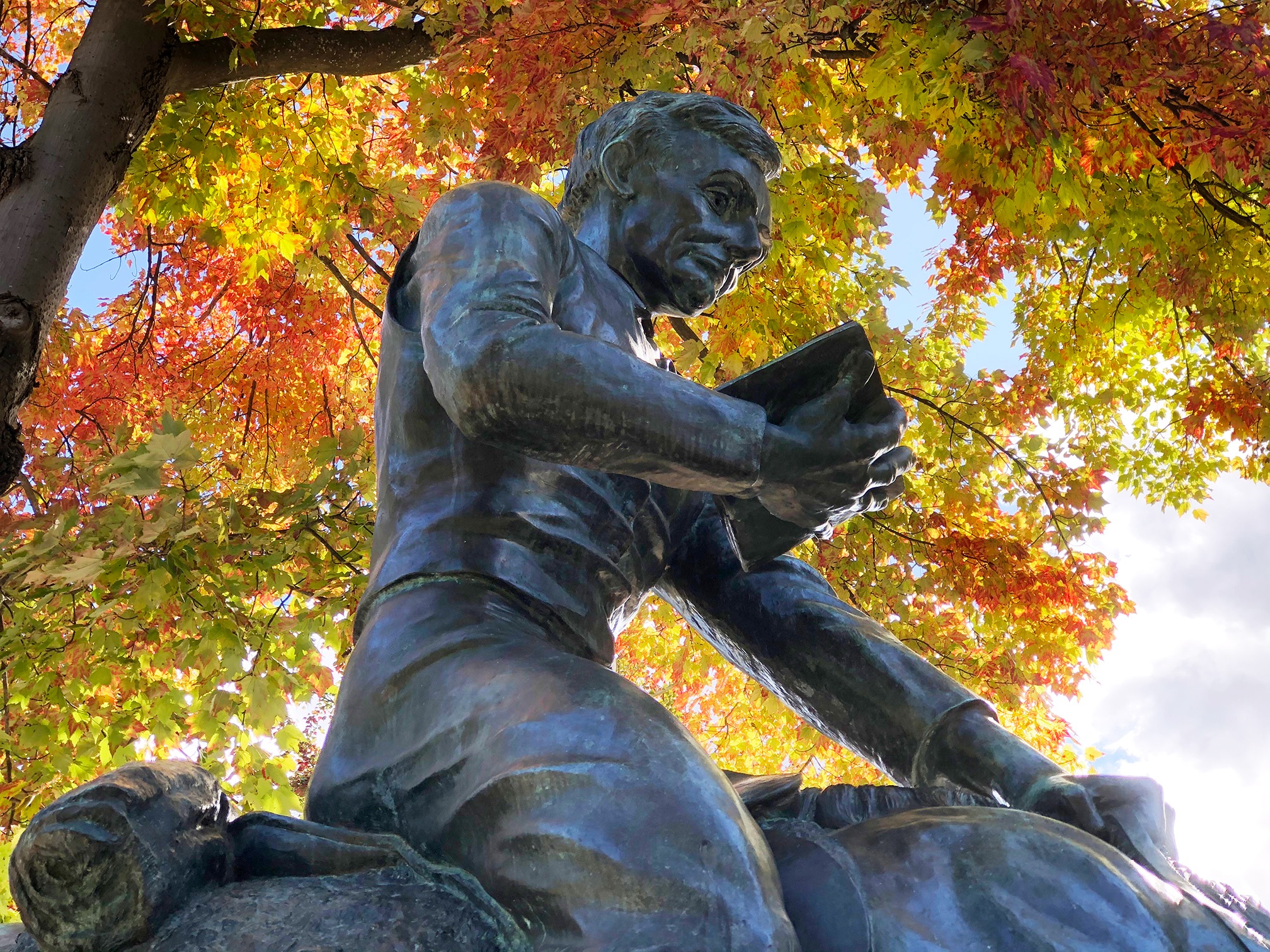
Bronze statue of a man sitting on a horse, reading a book, with trees in the background, symbolizing the pursuit of knowledge inspired by the Northwood Idea at Northwood University.

Limited Government & Rule of Law

This module emphasizes the importance of limited government, the rule of law, and a strong civil society in preserving freedom. Laws should maintain peace, not enforce personal virtue, and government power must be restrained by both permissions and prohibitions, as laid out in the Constitution and Bill of Rights. True self-governance depends on respecting constitutional rules and fostering voluntary associations that strengthen community and support freedom.

Waving American flag with red and white stripes and white stars on a blue field, set against a dark background, symbolizing pride at Turning Point USA Northwood.

Solving Problems in Freedom

This module highlights the role of civil society in strengthening community through voluntary associations and argues that market competition, not government regulation, often protects consumers. It also embraces inequality as a natural outcome of freedom and prosperity. Lastly, it critiques the debt ceiling and inflationary policies, emphasizing the need for constitutional spending limits to address fiscal issues.

Featured Course Videos

Economic Freedom

In the economically free society, individuals are free to engage in the peaceful use of their own property. Greater economic freedom not only promotes faster economic growth and higher living standards, it is also associated with lower poverty, more democracy, higher life expectancy, and many other desirable outcomes.

Singapore is a prime example of a poor developing country that prioritized economic freedom to become one of the world’s most prosperous countries. 

By Dr. Dale Matcheck, Professor and Department Chair of Economics at Northwood University

America’s Debt Crisis

The debt ceiling– the total amount of debt the federal government can legally borrow – is not the solution to America’s fiscal crisis. Congress routinely raises it whenever it threatens to constrain government spending.

Only a binding constraint on spending embodied within the U.S. Constitution can effectively limit the growth in our national debt.

By Dr. Michael Makovi, Associate Professor of Economics at Northwood University

The Vocation of Business

We often think that businesspeople are only motivated by money.   But in the context of the free enterprise system, making money requires its own set of virtues.

Ultimately, there is only one honorable way of making money in a free enterprise system. You get wealth by serving others, solving their problems, giving them a better option. Talent, hard work, or luck can play a role, but the real criterion for success is this – is someone better off because of your efforts? 

By Dr. Dale Matcheck, Professor and Department Chair of Economics at Northwood University

America is Not a Democracy

The American Founders did not intend America to be a democracy. They understood from history that democracies which are limited only by the will of the people often lose their freedom.

Instead, they left us a republic— a government that would serve the interests of the people but whose power would be limited by law.

By Dr. Glenn Moots, Professor and Department Chair of Political Science and Philosophy at Northwood University
Learn About Free Enterprise from the Experts at Northwood University